

And No Birds Sang Poem
'La Belle Dame sans Merci' is a ballad from the Romantic period. It was office of a literary motility that had arisen to counter the theories of the Age of Enlightenment – to bring back imagination, dazzler, and fine art to a culture that had go science-based, theoretical, and realist. Romantic writers saw the violence of the French Revolution as proof of the failure of science and reason, and the suffocation of the human spirit.
Most of John Keats' prolific works were written in 1819, shortly later on he met the honey of his life, Fanny Brawne, and contracted a mortal disease. Keats' poems focus on a return to beauty: Greek myth, fairies, idealism, nature, and individualism are all prominent themes in not but his piece of work, but of Romantic literature as a whole.
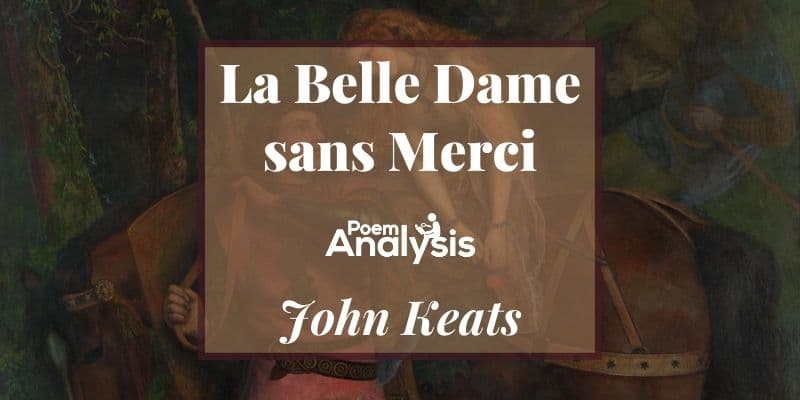
Summary
'La Belle Matriarch sans Merci' by John Keats is a beautiful poem about a fairy who condemns a knight after seducing him with her singing and looks.
The first three stanzas innovate the unidentified speaker and the knight. The speaker comes beyond the knight wandering around in the dead of winter when "the sedge has withered from the lake/ And no birds sing." In this way, Keats depicts a barren and bleak landscape.
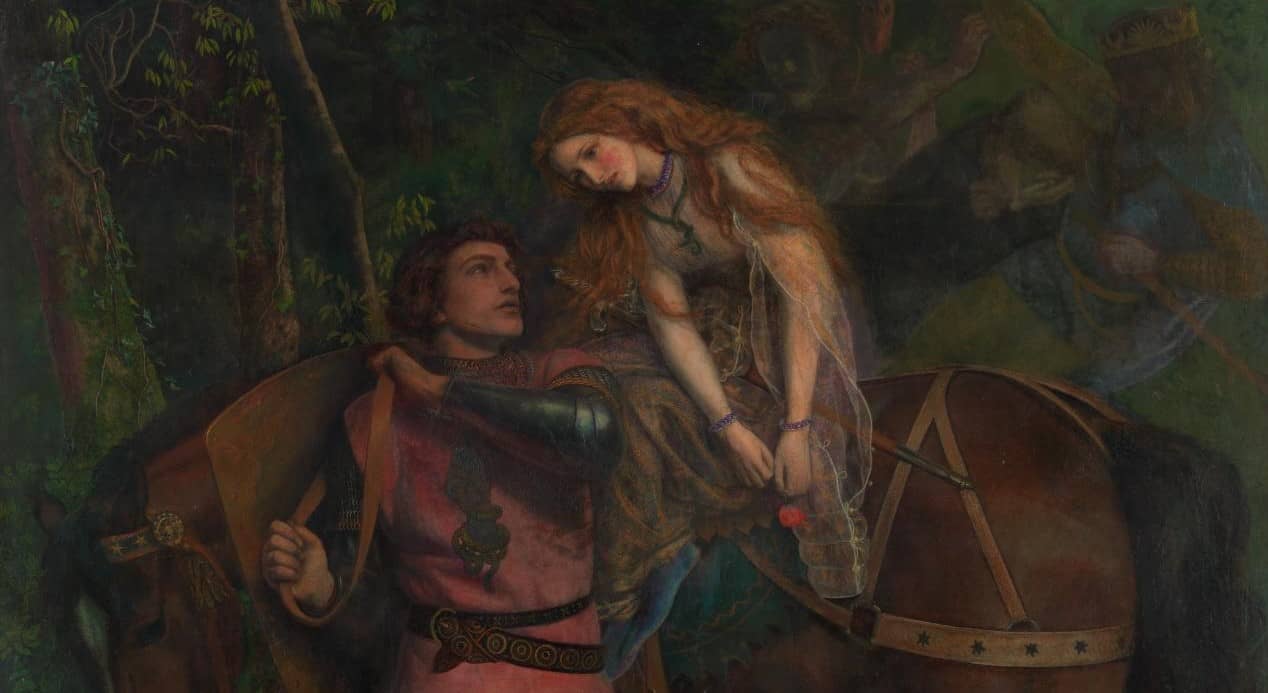
The knight responds to the speaker, telling him how he met a lady in the meadows who was "full beautiful, a faery'south child". Hither, Keats' linguistic communication sweetens. The first three stanzas were bitter and devoid of emotion, but the introduction of the "lady in the meads" produces softness in the linguistic communication of the knight. He reminisces on the lady'due south beauty and her apparent innocence – her long hair, calorie-free anxiety, and wild optics – and on her otherworldliness, every bit well. Moreover, he describes his sweet memories of the Lady: feeding each other, giving her presents, traveling with her, and being together.
In the 8th stanza, the lady weeps for she knows that they cannot be together equally she is a fairy, and he is a mortal. She lulls him to sleep out of which he does not immediately wake. In his dream, the knight sees pale people similar kings, princes, and warriors. They tell him that he has been enthralled past the adult female without mercy. He wakes up from the nightmare alone, on the cold hillside, and tells the persona that is why he stays at that place, wandering, looking for the lady. The last stanza leaves the fate of the knight cryptic.
Pregnant
Keats' ballad 'La Belle Dame sans Merci' describes the brusk come across betwixt a knight and a fairy lady. The title of the poem is interesting equally it isn't Keats' ain invention. He adopted the title of Alain Chartier's French ladylike poem 'La Belle Dame Sans Mercy'. In French, the phrase means, "A Beautiful Lady Without Mercy". Readers can see the variation of the words "Mercy" and "Merci". It seems that Keats went with the French spelling of the word.
Alain Chartier wrote that poem presumably in 1424 and the poem consists of 100 stanzas. Whereas, Keats' poem is comparably short and doesn't follow Chartier's octosyllabic line pattern. Apart from that, as the poet chose direct a French phrase, the title also follows the French pronunciation.
Structure and Class
'La Belle Dame sans Merci' is afterwards the course of the lyrical ballad. Many well-known poets of the romantic era used this class in their written works. This item carol has a meter and rhyme scheme that produces a flow that engages the reader.
The poem is written in iambic tetrameter, which simply ways that the stress falls on four words per line. The effect of this scheme is that it flows like a song, smoothly and with rhythm. Thus, information technology is called a lyrical ballad. The rhyme and rhythm are all designed to lure the reader in, just as the knight in the poem was lured in by the beautiful fairy-woman.
Keats wrote this in an outdated form of poetry that capitalizes on unproblematic language and imagery to bring across its story. By utilizing the ballad form, information technology lends the poem an air of timelessness, and an almost novelistic approach to imagery. Even the story itself is evocative of the carol tradition. Ballads were used as entertainment, and their length was supposed to go on listeners engaged, as the ballad was a form of oral poetry.
Tone and Mood
The tone and mood of this poem are also designed to help the readers to identify with John Keats' feelings every bit he neared the cease of his life. 1 could argue that the Knight in this poem is Keats himself. Although there are some differences between his life and the knight's story, there are certainly plenty of similarities that would advise that he uses the knight as a speaker to proclaim to the earth but what he feels as he neared his untimely death.
Literary Devices
Keats' 'La Belle Dame sans Merci' contains several literary devices that make the emotional story of the "knight-at-artillery" more heart-touching to the readers. These include but are non limited to:
- Anaphora: The poem begins with an apostrophe. Using it, the poet introduces the knight likewise as evokes his spirit into the poem.
- Metaphor: In "squirrel's granary" the poet uses a metaphor. Hither, the poet refers to the squirrel's pigsty. In "fever-dew" at that place is a metaphor and the comparison is between the dew and the fever.
- Personal Metaphor: In "starved lips" in that location is a personal metaphor.
- Metonymy: The word "death-stake" is a metonym. The kings and princes look stake as they accept died. Information technology's a reference to the cause in identify of the effect of beingness pale.
- Synecdoche: The poet refers to the color of the lily in the line "I see a lily on thy brow". It's a apply of synecdoche.
- Ingemination: Information technology occurs when the poet uses the same consonant sounds at the beginning of lines. For example, "Full" and "faery" in line two of the fourth stanza and "light" and "long" in the post-obit line. The phrase "her hair" contains another ingemination.
- Circumlocution: The phrase, "fragrant zone" contains this device. Information technology seems that the knight has made a garland that touches the lady's bosom.
- Allusion: There is a biblical allusion in the line, "And honey wild, and manna-dew".
- Palilogy: The poet uses this device past repeating the word, "wild" twice.
- Repetition: The last stanza contains a repetition of the idea present in the offset line of the poem.
- Caesura: It occurs when the poet uses a pause in the middle of a line. For example, "And at that place I dreamed—Ah! woe betide!—" and "Full beautiful—a faery's kid."
- Imagery: It tin can be seen through the powerful images in the knight's dreams as he's forced to suffer terrible nightmares. For example, "I saw their starved lips in the gloam, / With horrid warning gapèd broad."
Analysis, Stanza past Stanza
Stanza 1
O what tin can ail thee, knight-at-arms,
Alone and palely loitering?
The sedge has withered from the lake,
And no birds sing.
With the opening stanza of 'La Belle Dame sans Merci,' the speaker sets upwardly the scene and the discipline of this poem. The speaker comes upon a knight. He knows that this man is a knight upon seeing him, but he quickly reveals that this knight is not behaving equally one might expect a knight to behave. The character does not seem brave and valiant. Rather, he is alone and "loitering". He seems to be wandering nearly aimlessly.
The speaker wonders why, and he asks. He also remarks nigh the time of yr and claims that "the sedge has withered from the lake/ And no birds sing". Here, he is indicating that spring is over, and there is no lively singing or springtime beauty in the atmosphere. He wonders why the knight would be wandering about, pale and lone, during this fourth dimension of the twelvemonth. It is probably growing cold, every bit the birds accept flown southward already. The speaker finds it apropos that this knight is sickly and alone, without shelter, at this time of the year.
Information technology is important to notation hither that during the summer of 1818, Keats' younger blood brother Tom succumbed to tuberculosis. In the very same yr, Keats began exhibiting symptoms of the illness, and thus impending decease was heavy on his heed. It gets reflected in the very first stanza of the verse form.
Stanza Ii
O what can ail thee, knight-at-arms,
So haggard and and then woe-begone?
The squirrel's granary is full,
And the harvest'due south done.
With this stanza, the reader can grasp the full picture of what the Knight looks similar. The speaker describes him as "alone", "pale", "haggard", and "woe-begone". The setting is also described. It seems that the harvest is done. Therefore, the reader can imagine the bare, dry footing and the silence of nature later the birds have already flown south. Overall, this clarification gives 'La Belle Dame sans Merci' a very gloomy tone. The subject is down-trodden, and nature itself seems stripped of all joy. The birds have ceased their singing and the squirrels take stored up enough food to go into hiding. Thus, the lonely knight is left utterly alone.
Stanza Three
I encounter a lily on thy brow,
With anguish moist and fever-dew,
And on thy cheeks a fading rose
Fast withereth too.
In this stanza, the speaker informs the knight that he looks very ill. He tells him that his face is every bit stake as a lily and that his confront looks moist with sweat as if he had a fever. All of his colors are fading apace from his cheeks. It appears the speaker is very concerned about the knight'south health. He speaks to the knight to brand sure he is aware of how sick he is. In the following stanza, the knight answers him.
Stanza Four
I met a lady in the meads,
Total beautiful—a faery's child,
Her pilus was long, her foot was light,
And her optics were wild.
The speaker is now the knight as he gives answers to the concerns of the first speaker. He tells him of a lady that he met and describes her long pilus and her light footstep. Her eyes were "wild". It is articulate from this stanza, that the knight cruel in dearest at the first sight of this lady he describes. He describes her as not quite human. The knight doesn't refer to her as fully fairy, but he does call her a "faery's child" which gives the reader the impression that she is at least half fairy.
Stanza Five
I made a garland for her head,
And bracelets too, and fragrant zone;
She looked at me as she did love,
And made sweet moan
In this stanza, the knight describes his human relationship with this lady. Information technology appears that he won her middle. He made her a garland of flowers for her head. Then he made her bracelets from flowers. He also adorned her individual parts with flowers. This is implied when he says that he put flowers on her "fragrant zone". And so the knight implies that he made love to this adult female. He says that "she looked at [him] equally she did love" and that she made a sweet moan. This implies that the ii were intimate with i another.
Stanza Six
I set her on my pacing steed,
And cypher else saw all day long,
For sidelong would she bend, and sing
A faery'south song.
The sixth stanza tin can exist read as an extension of the previous stanza, where the lady riding the knight's stallion is an extended metaphor for their continued sexual relations. On the other hand, information technology could be read literally. In this case, the knight would have placed her on his horse and watched her ride "all 24-hour interval long" while she sang. In either instance, the knight is so entirely captivated with this woman that he sees and hears nothing else. He is devoted to her the unabridged twenty-four hour period long.
Stanza Seven
She found me roots of relish sweet,
And beloved wild, and manna-dew,
And sure in linguistic communication foreign she said—
'I love thee true'.
This stanza continues to draw the fairy woman's supernatural qualities. She feeds him sugariness roots, wild dear, and manna. The "roots of relish sweet" refer to her human qualities, but the manna and the wild honey are symbolic of her supernatural qualities. In the Jewish religion, information technology is told that God fed the Israelite's bread from heaven called manna. This same God promised the Israelites a state flowing with milk and honey. Thus, the fact that the fairy-woman was able to feed him staff of life from heaven, wild honey, and roots suggests that the fairy is part homo, role supernatural. The reference to "language strange" is yet another evidence of the lady'south unnatural lineage.
Stanza Eight
She took me to her Elfin grot,
And there she wept and sighed full sore,
And there I close her wild wild eyes
With kisses iv.
The knight continues to depict the fairy woman'south qualities. He describes her cavern, or "grot" as something elf-like in nature. Then, he gives her human characteristics once over again when he says that "she wept and sighed full sore". He does not explain why she cried, simply he does imply that he wiped her tears away with his kisses. This occurs between the knight and the fairy-woman allows the reader to sympathize the depth of their relationship. Earlier in 'La Belle Dame sans Merci', they connected physically. Here, they connect emotionally as the knight is there to wipe away her tears.
Scholars are divided on the precise motives of the lady while classes of scholars believe that the lady's weeping in the "Elfin grot" does bring up the ideas of undivided love. Several scholars believe otherwise. Notwithstanding, it seems that information technology is the latter. The lady understands that they cannot be together, and chooses to go out him to sleep.
Stanza Nine
And at that place she lullèd me comatose,
And at that place I dreamed—Ah! woe betide!—
The latest dream I ever dreamt
On the common cold loma side.
With this stanza, readers can begin to feel a little uncertain virtually this fairy-adult female. They should question why she is lulling this Knight to sleep. In the previous stanza, she cried, and there, no reason was offered for her tears. At present, she lulls him to sleep.
The knight has a dream. Information technology is a nightmare. For in his recollection of this dream, he cries out "Ah! Woe betide!" which suggests that this dream was woeful. Then he says that this was "the latest dream I ever dreamt" which suggests that it was the terminal dream that he would ever dream. He does not explain how he knows that this was the last dream he would e'er have, but he seems so confident of it that the reader does not question it.
Suddenly, this poem has taken a plow for the worse. Something atrocious has happened, and the reader tin begin to understand that the fairy-woman is at fault, just at that place are no specifics given just even so.
Stanza Ten
I saw pale kings and princes too,
Pale warriors, expiry-pale were they all;
They cried—'La Belle Matriarch sans Merci
Thee hath in thrall!'
At this signal, the knight begins to depict the "stake kings and princes" that he saw in his dream. In this instance, "stake" is a symbol of death. Since 'La Belle Dame sans Merci' has already introduced biblical symbols of the supernatural, information technology is not too far-fetched to conclude that the pale warriors and princes and kings are all later on the likeness of the pale horse in the book of Revelation, the concluding volume of the New Testament. The pale equus caballus and rider of the Bible symbolize death and bring devastation.
This poem continues to become more and more nightmarish equally it continues. All of the pale kings, princes, and warriors cry out "La Belle Dame sans Merci". This, of course, is the title of the verse form. It is in French, and it translates to read "The Cute Woman Without Mercy".
Suddenly, amongst his dream, the Knight becomes aware of what is happening to him. He has been seduced by a woman who would show him no mercy. Non just that, but he is 1 of many who accept come to ruin at the hands of this fairy-woman.
Stanza Xi
I saw their starved lips in the gloam,
With horrid warning gapèd wide,
And I awoke and found me here,
On the cold colina'south side.
The knight comes to the full realization of what has happened to him. Every man that the fairy has ever seduced has died. He describes these dead men that were in his dream. They have "starved lips" and they looked at him "with horrid warning" but it was too late. The knight had already been seduced, and as a issue of his moment of pleasance, he now faces expiry. When he awoke from his dream, he establish himself "on the cold colina'southward side" with no fairy-adult female in proximity. From the original description of the knight, the readers can conclude that he is, in fact, dying.
Stanza Twelve
And this is why I sojourn here,
Alone and palely loitering,
Though the sedge is withered from the lake,
And no birds sing.
In the final stanza, the knight finally answers the original question of the start speaker. He claims that because of being seduced past the fairy-woman, he now sojourns "alone and palely loitering" in his near-expiry state. Keats ends 'La Belle Dame sans Merci' with the line with which the first stanza ends. He repeats the first speaker's observation that "the sedge is withered from the lake/ And no birds sing".
The readers are left to grieve the loss of the knight. He dies lone with no one to condolement him in his concluding moments. Not fifty-fifty the birds are there to sing a vocal to offering comfort in his death. He is utterly alone in his terminal moments, and all because he was seduced past that beautiful fairy-woman without mercy.
Although the linguistic communication used is simple, Keats manages to create ii parallel universes. The real world, where the knight is found alone, and palely loitering, is dark and dismal and wintery. The other world, where the Lady lives, seems exotic and beautiful, with such glorious foods as honey wild and manna-dew. The nightmarish imagery that exists betwixt the worlds can be taken to exist part and parcel of the lady's world, as it is she who whisks immature men away, willing or unwilling, to their doom.
Themes
'La Belle Matriarch sans Merci' contains several themes such as dejection in love, heartbreak, sadness, expiry, and illusion vs reality. The most of import theme of the poem is dejection in dearest. There is a sense of separation in the knights that makes him appear lifeless. His loitering in the wild without any hope depicts the need for beloved in his life. The lady'southward illusory existence makes him sadder about his reality. The person with whom he had spent some time, doesn't be at all. This thought pains the knight deep. Apart from that, the themes of sadness and heartbreak become side by side in the poem. The knight's mental status is so sad that the poet thinks fifty-fifty nature laments his loss.
It isn't fallacious to think that the theme of decease is besides an integral office of the verse form. While writing this poem, the poet was going through a similar kind of condition. It seems that through the story of the knight the poet somehow tried to express his feelings. He knew about his approaching death and also aware of the fact that unison with his beloved wasn't possible. As being close to entering the gate of death, the poet'due south mind was flooded with the thoughts of oblivion.
The first two stanzas reflect not only the knight'south but too the poet's state of mind. In the tenth stanza, the theme of decease is visible. Here, the dead kings and princes remind the knight that the lady without pity captivated his listen. Hence, it'due south useless to look whatever longer for her.
Historical Context
John Keats wrote 'La Belle Dame sans Merci' in the summer of 1819 when he was dying from tuberculosis. Then he was in Wentworth Palace, the home of his friend Charles Armitage Brown. Their neighbors at Wentworth Palace were Fanny Brawne and her female parent, and because they lived in the other one-half of Wentworth Palace, they saw each other daily. Later a while, he cruel in beloved with Fanny Brawne, though being poor, he could not marry her.
He had already seen his female parent and blood brother die from this terrible disease before he contracted it himself. The knowledge of his imminent death likely inspired this poem. While his mother died in 1810, he contracted the same affliction in 1819. He had seen the effect that the disease had on his female parent and his blood brother, and he knew what was to come for himself.
Fifty-fifty more tragic than his wrinkle of tuberculosis is that he was newly engaged and badly in love. He claimed that he could bear to die, only he could not bear to leave his love. It is not hard to make a connexion between this verse form and Keats' life. Although he does not appear to view his real-life love every bit the cause of his death, there remain striking parallels. Both the knight in this verse form and John Keats himself barbarous in love presently before death. Both were unable to savour love for very long before decease became imminent in their lives.
Well-nigh John Keats
Sadly, John Keats, one of the all-time 18th-century British poets, died at the immature age of twenty-5. Having studied some medicine, Keats knew his symptoms well enough to know that his fourth dimension was limited. Just equally Keats had found dearest, all-time just as his poetry was beginning to be noticed, he faced his early death. Being fully enlightened of his symptoms and the result of his affliction, Keats also faced depression. It occurred to him his life was to terminate merely equally it was first. He left behind a fiancee whom he desperately loved and a plethora of poems that would somewhen get some of the most renowned and beloved John Keats poems of all time.
FAQs
What does 'La Belle Matriarch sans Merci' mean in English?
The meaning of "La belle dame" is "the beautiful lady". The French preposition "sans" means "without" and "merci" is a French exclamation for maxim "thank you lot". Only the word "merci" stands for the English give-and-take "mercy" in the title of Keats' poem. Literally, information technology means "The Beautiful Lady Without Mercy".
How is 'La Belle Dame sans Merci' a romantic poem?
Keats' 'La Belle Dame sans Merci' is a pure romantic poem. Several characteristics of romantic poesy can be found in this poem such as imagination, nature, melancholy, medievalism, supernaturalism, and subjectivity.
How is 'La Belle Dame sans Merci' a tragedy?
This ballad presents a tragic character and his destiny after being deceived by the unmerciful lady. Keats' speaker describes his present status past depicting his mental state too as the ambiance effectually the character. Information technology is a tragic poem as the hero suffers badly for the choice (intentional or unintentional) he made after encountering the lady for the kickoff time.
What is the nature of "La Belle Matriarch"?
The "La Belle Dame" was "sans merci" or without mercy as the title of the poem asserts. Her physical dazzler was so lucrative that the knight could not help but fall in dear with her in the first instance. Her "wild eyes" hints at the nature of the lady. She stole the knight'due south middle just she abstained hers.
What did the beautiful lady requite the "knight-at-arms" to eat?
The cute lady gave sweet roots, wild dear, and manna-dew to the "knight-at-arms".
Why is the knight in 'La Belle Dame sans Merci' so pale and sick?
The knight was all lone on the cold colina's side when he awoke from his dream. The lady who said, "I love thee true" left him later she lulled him to sleep. For the abrupt ending of his love story, he was extremely distressing and his physical appearance reflected his mental state.
What does the knight souvenir the beautiful lady?
The knight gifted the lady a handmade garland, bracelets, and final but non least 4 warm kisses.
Similar Poetry
Similar Keats' 'La Belle Dame sans Merci', here is a list of a few poems that similarly talks most a lady's unmerciful attitude towards a devoted lover. Readers who enjoyed this poem should also consider reading more John Keats poems such as 'When I have Fears that I may Cease to Be,' 'Ode to Psyche,' 'Vivid star, would I were stedfast as g art,' etc.
- Honey by Samuel Taylor Coleridge – Information technology'due south ane of the best Samuel Taylor Coleridge poems. This poem details the emotional and physical relationship betwixt a lover and the woman he woos through storytelling. Explore more Due south.T. Coleridge poems.
- A Exit-Taking by Algernon Charles Swinburne – In this verse form, the speaker discusses how he took leave from the lady who rejected the poet every bit well as his songs. Read more Algernon Charles Swinburne poems.
- Sonnet 134: And then now I have confessed that he is thine by William Shakespeare – In this Shakespearean sonnet, regarded as one of his best love sonnets, the poetic persona addresses the Dark Lady who has seduced the Fair Youth. Explore all 154 of William Shakespeare's Sonnets and the greatest sonnets of Shakespeare.
- Sonnet 11 by Lady Mary Wroth – In this sonnet, the woman speaker describes her feelings and expressions subsequently her love has been unfaithful to her. The tone and mood of the verse form are similar to that of Keats' poem. Read more Lady Mary Wroth poems.
You can also read nigh these incredible poems on death and memorable unrequited love poems.

And No Birds Sang Poem,
Source: https://poemanalysis.com/john-keats/la-belle-dame-sans-merci/
Posted by: hoffmannhitche.blogspot.com
0 Response to "And No Birds Sang Poem"
Post a Comment